How to Choose the Right Wattage for Your LED High Bay Lights

Table of contents

Introduction

Struggling with dim warehouse aisles, crippling energy bills from outdated metal halide fixtures, or the constant expense of replacing bulbs in hard-to-reach ceilings? You’re facing a common industrial dilemma. Choosing the wrong wattage for your LED high bay lights isn’t just a minor error – it’s a decision that fuels ongoing energy waste, undermines workforce productivity, and introduces tangible safety risks across your facility. Each day with improper lighting silently drains your operational budget and potential.

This guide is your essential roadmap to a solution. We transcend basic wattage recommendations to deliver a comprehensive framework focused on optimizing Total Cost of Ownership (TCO). Our goal is to equip you to dramatically enhance operational efficiency and meet critical environmental targets through strategic lighting intelligence.

Coydon Lighting, your expert partner in industrial LED solutions, provides this authoritative knowledge. We merge superior, high-efficiency products with cutting-edge professional design tools. Through this article, we will guide you with precise methodologies and proven, real-world project evidence.

You will gain mastery over the exact science of calculating your ideal wattage and lumen requirements. More importantly, you will develop a deep understanding of all critical technical parameters that dictate project success. This knowledge is your key to making the most informed, cost-effective, and future-proof investment for your space. Let’s illuminate the path to maximum savings and performance.

Part 1: Why Wattage Alone Is a Misleading Metric

For decades, choosing industrial lighting was straightforward. You simply matched the wattage – a 400W metal halide high bay light, a 250W for a lower one. This approach worked because, with traditional technologies, power consumption (watts) was directly and crudely linked to light output. More watts meant a brighter, hungrier bulb. However, the LED revolution has fundamentally shattered this old rule. Focusing solely on watts today is like choosing a truck based only on its fuel tank size, ignoring its engine efficiency and cargo capacity. It’s a costly shortcut that leads you astray.

1.1. The Lumens Revolution: From Power Consumed to Light Delivered

The legacy of the wattage-centric mindset stems from an era of limited technology. With Metal Halide (MH) or High-Pressure Sodium (HPS) lamps, there was little variation in efficiency. A 400W MH lamp from any brand would produce a roughly predictable, albeit inefficient, amount of light. The industry standard was the wattage rating.

This is why a paradigm shift is critical. You must now think in terms of light delivered, not just power consumed.

  • Watts (W) measure energy input – the electrical power a fixture “eats.” It tells you your operational cost.
  • Lumens (lm) measure light output – the total quantity of visible light a fixture “emits.” It tells you the actual brightness on your workspace.

This distinction leads us to the most important metric in modern lighting: Luminous Efficacy, measured in lumens per watt (lm/W). This is the efficiency engine of your light. It tells you how skillfully a fixture converts electricity into usable light. A higher lm/W rating means more lumens per watt consumed – more light for your money.

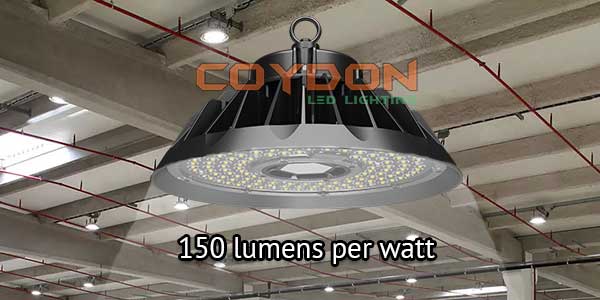
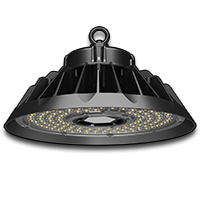
Here’s where the choice of supplier matters critically. While many fixtures offer decent efficiency, leading-edge technology delivers superior performance. At Coydon Lighting, our UFO LED High Bay Light series achieves an exceptional luminous efficacy of up to 150 lm/W. This means compared to industry averages of 130-140 lm/W, our fixtures deliver significantly more light from the same electrical input, or the same light for less cost. This efficiency advantage is built into every chip and driver, translating directly to your long-term savings.

1.2. The High Cost of “Guessing” the Wattage

Relying on old wattage rules or rough estimates for your new LED system invites two equally problematic and expensive scenarios. The cost of guessing extends far beyond the initial purchase.

Scenario 1: The Over-Wattage Trap

Installing fixtures with excessive lumen output for your space is wasteful and counterproductive. It creates intense glare and discomfort for workers, leading to eye strain and reduced visibility – the opposite of the desired effect. This “light pollution” within your facility wastes a tremendous amount of energy, directly inflating your electricity bill. Furthermore, consistently over-driving or improperly dissipating heat in an overpowered setup can stress the LED components, potentially shortening their lifespan and voiding warranties. You pay more upfront, more monthly, and potentially more in premature replacements.

Scenario 2: The Under-Wattage Pitfall

The more common, and often more dangerous, error is under-lighting. Fixtures with insufficient lumen output leave your workspace in shadows. This critically low illumination creates hazardous conditions for material handling, machinery operation, and safe movement, increasing the risk of accidents and injuries. Workers must strain to see details, leading to fatigue, errors, and plummeting productivity. The financial impact here is twofold: ongoing safety liabilities and a significant loss in operational throughput. You save a little on the initial purchase and energy, but you pay heavily in risk and lost revenue every single day.

Both scenarios prove that an incorrect wattage choice is not a one-time error. It locks in a continuous cycle of higher operational costs, safety compromises, and productivity drains. The true metric for success isn’t the wattage on the box; it’s the precise, optimal light delivered to your task surfaces.

Part 2: The 4-Step Formula to Calculate Your Perfect Wattage

Understanding why watts are misleading is the first step. Now, let’s master the precise methodology for determining exactly what you need. This proven, four-step formula transforms guesswork into an exact science, ensuring your lighting investment delivers optimal performance and maximum return.

2.1. Step 1 - Measure And Define Your Space

Every successful lighting design starts with accurate foundational data. Grab a tape measure and note these three critical details:

  • Mounting Height (H): Measure from the finished floor to the intended mounting point of the fixture. This is not always the ceiling height if using suspension rods or chains. This measurement directly influences light spread and intensity.
  • Area Dimensions: Measure the length and width of the space to be illuminated. Area (A) = Length (L) x Width (W). Use square feet (sq ft) or square meters (m²).
  • Space Purpose And Required Illuminance: What activities occur here? Different tasks demand different light levels for safety and accuracy. This requirement is measured in foot-candles (fc) or lux (lx) (1 fc ≈ 10.76 lx). Refer to this quick reference table:
Application / Task TypeRecommended Illuminance Level (Foot-candles / Lux)Notes
General Warehousing / Bulk Storage10-20 fc / 100-200 lxFor aisles, locating large items.
Active Warehousing / Order Picking20-30 fc / 200-300 lxReading labels, manual handling.
Workshops / Assembly Areas30-50 fc / 300-500 lxFor mechanical work, basic assembly.
Detailed Manufacturing / Inspection50-100+ fc / 500-1000+ lxPrecision tasks, quality control.
Retail Sales Areas20-50 fc / 200-500 lxProduct display and customer ambience.
Gymnasiums / Sports Halls30-50 fc / 300-500 lxGeneral athletic activity.

2.2. Step 2 - Calculate Your Total Lumen Requirement

With the area (A) and your target illuminance level (E) from Step 1, you can calculate the total amount of light needed for the entire space. This is your Total Lumen Requirement (Φ_total).

The fundamental formula is: Φ_total (lm) = Area (sq ft) x Target Illuminance (fc)

  • Example: For our 10,000 sq ft active warehouse targeting 30 fc for order picking.
  • Calculation: Φ_total = 10,000 sq ft x 30 fc = 300,000 lumens.

This is the total luminous flux required at the work surface level when the lighting system is new and clean.

2.3. Step 3 - Factor in Real-World Conditions

A lighting system is not installed in a perfect, lab-controlled vacuum. Over time, performance degrades. Step 2’s “theoretical” number must be adjusted for reality to ensure your space remains properly lit years from now.

This adjustment is made using a Light Loss Factor (LLF) or Maintenance Factor (MF). It accounts for:

  • Lumen Depreciation: LEDs slowly lose output over their lifetime (L70, L80 ratings).
  • Dirt Accumulation: Dust and grime on fixtures and room surfaces reduce light output.
  • Environmental Factors: Ambient temperature and voltage fluctuations can affect performance.

A typical, conservative LLF for an industrial LED system is 0.70 to 0.80. We’ll use 0.80 for our example.

The updated, real-world formula becomes: Required Installed Lumens (Φ_installed) = Φ_total / LLF

  • Example Continued: Φ_installed = 300,000 lm / 0.80 = 375,000 lumens.

This step is what separates professional designs from amateur guesses. It ensures your initial installation has enough capacity to maintain the target light level throughout its life.

2.4. Step 4 - Select Your Fixture and Determine Quantity

Now, match the calculated Required Installed Lumens to real products to find your fixture count and final wattage.

  • Determine Quantity: Divide the total installed lumens by the lumen output of your chosen fixture.
  • Number of Fixtures (N) = Φ_installed / Lumens per Fixture (Φ_fixture)
  • Understand Final Wattage: The wattage of your chosen fixture is secondary, derived from its lumen output and efficacy.
  • Fixture Wattage (W_fixture) = Φ_fixture / Luminous Efficacy (lm/W)

Coydon Lighting Application And Case Study:

Let’s apply this to our 10,000 sq ft warehouse example using Coydon’s high-performance UFO LED High Bay Light series.

  • Fixture Choice: According to our KD-HBD series specifications, a 200W UFO LED High Bay Light delivers approximately 30,000 lumens (calculated as: 200W x 150 lm/W efficacy).
  • Calculate Quantity: N = 375,000 lm / 30,000 lm per fixture ≈ 12.5 fixtures. We round up to 13 fixtures to ensure even coverage.
  • Total System Power: 13 fixtures x 200W = 2,600 Watts of connected load.

The Powerful Value Proposition:

This result reveals a key competitive advantage. A single 200W Coydon UFO LED high bay light, producing 30,000 lumens, can effectively and efficiently replace a traditional 400W Metal Halide high bay light (which typically produces only 25,000-35,000 lumens at end-of-life while consuming double the power). This translates to an instant reduction in energy consumption of 50% or more per point of replacement, before even considering the multi-year savings from reduced maintenance and longer lifespan. Your perfect wattage isn’t just a number – it’s the gateway to drastic operational savings.

Part 3: Beyond Wattage: Critical Parameters That Make or Break Your Project

Calculating the perfect wattage is the engineering core of your project. However, specifying a lighting system that truly excels in the real world requires attention to finer details. These parameters dictate the quality of light, the longevity of your investment, and its ability to adapt to your facility’s evolving needs. Ignoring them can undermine even the most precise lumen calculation.

3.1. Beam Angle And Optics: Directing Light Where You Need It

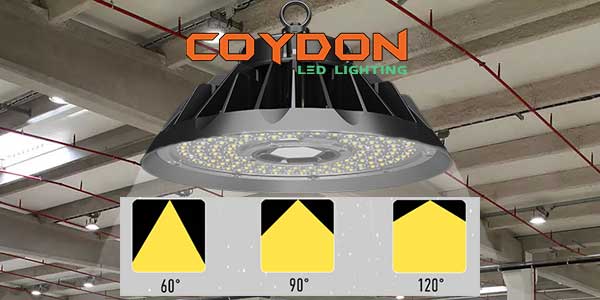
The beam angle is the cornerstone of light distribution. It defines the cone of light emitted from the fixture, measured in degrees where the light intensity falls to 50% of its maximum. This single specification profoundly impacts coverage, uniformity, and visual comfort.

  • Narrow Beam (e.g., 60°): Concentrates light into a more focused pool directly beneath the fixture. Ideal for very high ceilings (over 40 ft), spotlighting specific workstations, or illuminating tall, narrow aisles. It minimizes light spill but requires careful spacing to avoid dark spots between fixtures.
  • Medium Beam (e.g., 90°): The most versatile and common choice for general high bay applications (15-30 ft ceilings). It provides an excellent balance of downward intensity and side spread, ensuring good overlap between fixtures for uniform illumination across open warehouse floors and manufacturing areas.
  • Wide Beam (e.g., 120°): Disperses light over a broad area with less peak intensity directly below. Best suited for lower mounting heights (15-20 ft) or in spaces where extremely even, shadow-free lighting is paramount, such as in some retail environments or gymnasiums.

Choosing the wrong beam angle leads to uneven “scalloping” (bright spots under fixtures with dark aisles), excessive glare, or wasted light falling on walls. Coydon fixtures offer multiple beam angle options (60°/90°/120°), allowing our lighting specialists to model and recommend the precise optical design for your layout, minimizing dark spots and glare for optimal worker comfort and efficiency.

3.2. Color Quality: Seeing True for Safety and Accuracy

Light isn’t just about quantity; its quality directly affects perception, safety, and task performance. Two metrics are crucial: Correlated Color Temperature (CCT) and Color Rendering Index (CRI).

Correlated Color Temperature (CCT):

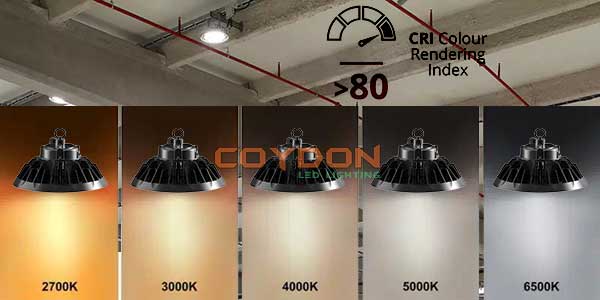
Measured in Kelvins (K), CCT describes the visual warmth or coolness of white light.

  • 3000K (Warm White): Creates a cozy, relaxed atmosphere. Suitable for break rooms or some retail spaces but generally not recommended for industrial tasks due to its yellowish hue.
  • 4500K (Neutral White): Offers a clean, balanced light that minimizes eye strain over long periods. A superb all-rounder for workshops and assembly areas.
  • 5000K-6000K (Cool White/Daylight): Mimics natural midday sun. This crisp, alerting light is the industry-preferred choice for warehouses, distribution centers, and manufacturing. It enhances contrast, reduces perceived drowsiness, and improves overall visibility for detailed tasks and safety signage.

Color Rendering Index (CRI):

CRI (Ra) measures a light source’s ability to reveal the true colors of objects compared to natural light, on a scale of 0 to 100. A higher CRI means colors look more vivid and accurate.

  • CRI 80+ (Good): The minimum standard for industrial and commercial spaces. It allows workers to accurately read labels, identify wire colors, and notice safety markings (e.g., yellow hazard stripes, red fire equipment).
  • CRI 90+ (Excellent): Essential for environments where color discrimination is critical, such as paint shops, textile manufacturing, or quality inspection stations.

All Coydon UFO LED High Bay lights feature a high CRI of 80+, ensuring that your investment in bright light also delivers clear, accurate, and safe visual information across your facility.

3.3. Durability And Protection: Built for the Real World

An industrial fixture must be as tough as the environment it serves. Specifications here are promises of reliability.

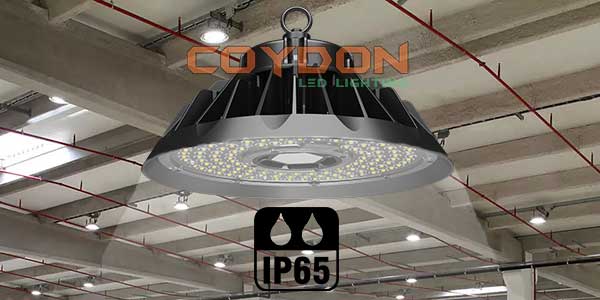
  • IP65 Rating – The Seal of Resilience: The Ingress Protection (IP) code is vital. IP65 means the fixture is completely dust-tight (6) and protected against water jets from any direction (5). This guarantees reliable operation in dusty warehouses, environments with occasional wash-downs, or areas with high humidity, safeguarding the internal electronics.
  • Robust Construction – Engineered for Longevity: The aluminum housing in Coydon fixtures serves a dual purpose: it provides structural strength and acts as an effective heat sink. Efficient thermal management is the #1 factor for LED longevity, preventing premature lumen depreciation. The PC (Polycarbonate) lens is highly impact-resistant, protecting the LEDs from accidental bumps or debris.
  • 5-Year Warranty – The Ultimate Confidence: A strong warranty is the manufacturer’s direct testament to product quality and durability. Coydon’s 5-Year Comprehensive Warranty is not just a promise; it’s our commitment to your long-term satisfaction and a reflection of the confidence we have in the robustness and performance of every component in our lights.

3.4. Smart Controls: From Static to Dynamic Savings

The most advanced fixture becomes exponentially more valuable when integrated with intelligence. Smart controls transform lighting from a constant overhead cost into an adaptive, responsive asset.

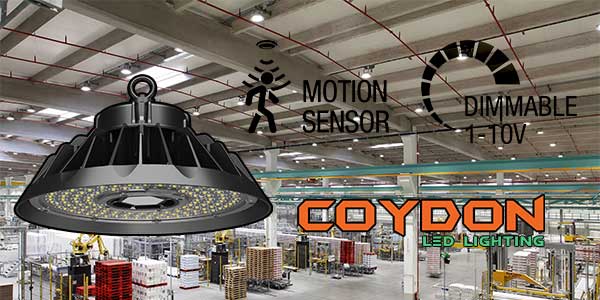
  • 1-10V Dimming And Microwave Sensors: Coydon fixtures are equipped with 1-10V dimmable drivers and are compatible with microwave (radar) occupancy/motion sensors. Unlike passive infrared (PIR) sensors, microwave sensors can detect subtle motion through obstructions and are ideal for high-bay applications.
  • The Intelligent Lighting Scenario: Imagine a warehouse where lights automatically brighten to 100% only when an aisle is occupied for picking. In storage areas visited only occasionally, lights remain at a low, safe 20% level, surging to full brightness only when motion is detected. Furthermore, fixtures near skylights can automatically dim in response to abundant daylight. This dynamic system can yield additional energy savings of 30-50% on top of the base LED efficiency, while also extending the fixtures’ operational life.
  • Future-Proofing Your Investment: Specifying dimmable, sensor-ready fixtures today means your lighting infrastructure is prepared. It can easily integrate with Building Management Systems (BMS) or IoT platforms in the future, allowing for data collection, predictive maintenance, and even more granular control. This isn’t just a purchase; it’s a strategic, forward-compatible investment in your facility’s efficiency.

Part 4: From Theory to Reality: A Coydon Lighting Case Study

Formulas and parameters are essential, but seeing them deliver tangible results in a real-world scenario is what truly builds confidence. Let’s walk through a project that demonstrates how Coydon Lighting’s methodology translates into measurable performance and savings.

4.1. The Challenge: A 23,000 sq ft Warehouse with Inconsistent Lighting

A major logistics operator approached us with a common yet critical problem. Their 23,000 square foot distribution center was illuminated by a patchwork of aging 400W metal halide (MH) fixtures. The lighting was plagued by severe inconsistencies: glaringly bright spots directly under fixtures, dark shadows in the aisles where order pickers worked, and a general yellowish hue that made reading small labels on boxes difficult and fatiguing. Beyond the poor light quality, the financial burden was heavy. Energy consumption was excessive, and the frequent failure of MH lamps and ballasts led to high maintenance costs and disruptive downtime, requiring lifts and specialized labor for replacements.

4.2. The Coydon Solution: Precision Planning with Dialux

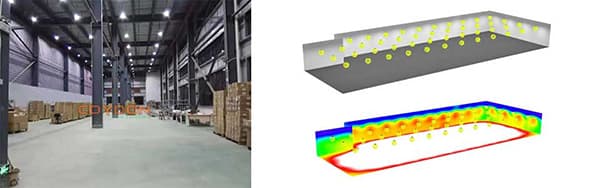
At Coydon Lighting, we don’t just sell lights; we engineer complete lighting solutions. For this client, the first step was a virtual, risk-free design and validation process. We provided a FREE professional Dialux lighting simulation report, a service we extend to qualified projects. This allowed us to move beyond guesswork and provide a precise, data-driven preview of the final installation.

Our PDF document, “Project 02 – Warehouse,” is a perfect example of this process. In this simulation for a similar-sized facility, we meticulously modeled the space and planned a layout using our high-efficiency 150W UFO LED High Bay Lights.

The Dialux report is a goldmine of verified performance data:

  • Optimal Illuminance: The simulation predicted an average illuminance of 338 lux on the workplane (approximately 31 foot-candles), perfectly aligning with industry standards for active warehousing and order picking.
  • Superior Uniformity: The uniformity ratio (U0) on the workplane was calculated at 0.389. This metric (where 1 is perfect uniformity) is critical; it proves the light is evenly distributed without dark spots or excessive glare, a vast improvement over their old MH system.
  • Maximum Efficiency: Despite delivering excellent light levels, the specific connected load was only 2.90 W/m². This figure demonstrates the exceptional energy efficiency of the design, showing how high-quality LEDs and smart layout minimize power consumption.

This report turned abstract concepts into concrete, predictable outcomes, giving the client absolute confidence before any physical work began.

4.3. The Verified Outcome: Efficiency, Savings And Satisfaction

Guided by the Dialux simulation, the project proceeded to installation. The results were transformative and fully validated the digital model.

  • Energy Savings: The new Coydon 150W UFO LED high bay lights replaced the old 400W metal halide (MH) high bay lights, slashing energy consumption for lighting by over 60%. For a 24/7 operation, this translated to tens of thousands of dollars in annual utility savings.
  • Light Quality Transformation: The warehouse was flooded with consistent, bright 5000K daylight. Workers reported dramatically improved visibility, reduced eye strain, and increased accuracy in picking and packing. Safety improved as hazards were now clearly visible.
  • Maintenance Costs Eliminated: With a rated lifespan of 50,000+ hours and a 5-year warranty, the cycle of constant lamp replacements and associated labor costs was broken. The maintenance budget for lighting effectively dropped to near zero.
  • Quantifiable ROI: The combination of drastic energy reduction and eliminated maintenance resulted in a calculated payback period of under 2.5 years. Every year thereafter represents pure operational savings and profit enhancement.

This case study underscores the core message: choosing the right wattage is vital, but pairing it with professional optical design, high-efficacy products, and robust construction is what unlocks the full, quantifiable return on investment. It moves the conversation from price per fixture to value per lumen delivered over a decade. This is the proven Coydon Lighting advantage.

Part 5: Your Action Plan: Getting Your Perfect LED High Bay Light Solution

You now possess the knowledge and framework to make a truly informed decision. The final step is to translate that knowledge into action. This straightforward action plan will guide you from consideration to a perfectly illuminated, highly efficient facility.

5.1. Checklist: Are You Ready to Choose?

Before you review any product catalog, complete this simple four-step checklist with your team:

  • Measure Your Space: Accurately record your ceiling height (mounting point), length, and width. Precise measurements are the foundation of an accurate design.
  • Define Your Application: Determine the primary tasks in each area. Refer to the illuminance table in Part 2. Is it bulk storage, detailed assembly, or retail? Define your target foot-candle levels.
  • Calculate Your Needs: Use the 4-step formula from Part 2. Calculate your total required lumens, apply a realistic Light Loss Factor (0.8), and determine the approximate fixture count and wattage needed.
  • Consider Smart Controls: Decide if occupancy sensors or daylight harvesting could benefit your operations. Planning for dimming and sensors future-proofs your investment and unlocks deeper savings.

5.2. Why Choose Coydon Lighting as Your Partner?

When your calculations are complete, partner with a provider who offers more than just a product. Choose Coydon Lighting for a comprehensive solution built on five key pillars:

  • Peak-Performance Products: Experience industry-leading efficiency with 150 lm/W from premium OSRAM LEDs, backed by a robust 5-Year Warranty for total peace of mind.
  • Professional Design Service: Eliminate guesswork with our FREE Dialux Photometric Simulation. We provide a detailed, data-driven preview of your project’s outcome before installation, guaranteeing optimal performance.
  • Intelligent, Future-Ready Technology: Our fixtures come ready for 1-10V dimming and microwave sensors, enabling automated control strategies that can boost your savings by an additional 30-50%.
  • Proven Energy And Cost Savings: Our 200W UFO LED High Bay Light effectively replaces a 400W Metal Halide high bay light, delivering immediate energy consumption reductions of 50% or more from day one.
  • End-to-End Partnership: We provide a true single-source solution – from initial consultation and technical design to reliable supply, support, and after-sales service.

5.3. Take the Next Step - It’s Risk-Free!

The path to optimal lighting is clear, and we are here to guide you every step of the way.

Stop guessing and start calculating with confidence.

Get a FREE, no-obligation Dialux simulation for your specific warehouse.

See exactly how much you can save with a customized lighting plan from Coydon Lighting.

Taking action is simple and carries no risk. Click the ‘Inquiry Now’ button below. Provide your basic space details and project goals. One of our dedicated lighting specialists will promptly contact you to discuss your needs in detail. We will then create and provide your personalized, professional Dialux simulation report at no cost, showcasing the exact performance and savings you can achieve.

Let us help you turn your lighting from a cost center into a strategic advantage. Start your journey to superior illumination and significant operational savings today.

Conclusion

Selecting the optimal LED high bay light is a critical business decision with far-reaching impact. While wattage provides an initial reference, the true measure of success lies in prioritizing lumens over watts, luminous efficacy over simple power ratings, and intelligent optical engineering over basic fixture placement. Most significantly, achieving perfect illumination requires the confidence that comes from professional planning, precise photometric analysis, and comprehensive simulation before installation.

Investing in a properly designed lighting solution delivers transformative long-term value that extends well beyond immediate energy savings. This strategic investment creates a fundamentally safer working environment by eliminating hazardous shadows and improving visibility of potential risks. It significantly boosts workforce productivity through enhanced visual comfort, reduced eye fatigue, and improved accuracy in all operational tasks. Ultimately, this approach ensures exceptional operational reliability by virtually eliminating maintenance disruptions and providing consistent, high-quality illumination throughout the fixture’s extended lifespan.

The future of industrial illumination is clearly defined by efficiency, intelligence, and precision engineering. Modern lighting solutions have evolved from basic utilities into powerful tools that deliver measurable competitive advantages across multiple operational dimensions. Your pathway to achieving optimal lighting conditions, realizing maximum energy savings, and creating a brighter, more productive facility begins with a single, decisive action. Take that step today to illuminate your path to operational excellence.

ufo led high bay lights 100 watt

100 Watt
KD-HBD-W100-1
Ø248mm X 129mm

ufo led high bay lights 150 watt

150 Watt
KD-HBD-W150-1
Ø295mm X 140mm

ufo led high bay light 200 watt 240 watt

200 Watt / 240 Watt
KD-HBD-W200-1 / KD-HBD-W240-1
Ø320mm X 154mm

Input Voltage:AC 90V – 305V
Colour Temperature:3000K / 4500K / 6000K
Color Rendering Index:80+
LED Type:LED SMD 2835 ( OSRAM )
IP Grade:IP65
Material:Aluminium + PC Lens
Luminous Efficiency:150 Lumens per watt
Beam Angle:60° / 90° / 120°
Warranty:5 Years
Mounting Height:100 Watt: 15–20 ft (4.5–6 m)
150 Watt: 20–30 ft (6–9 m)
200 Watt: 30–40 ft (9–12 m)
240 Watt: 40–50 ft (12–15 m)

Request a Free Quote

Send us a message if you have any questions or request a quote. We will be back to you ASAP!